

At a high-level, this article covers the general concept of a big bang (the start of the universe), the heat death (when all atoms are equally spaced due to entropy and there is no further expansion of the universe), as well as theories spanning the big crunch (an inward collapse of the universe after its heat death) and other concepts.
The article uses metaphors and images to demonstrate how these theories are compatible with life after death beliefs spanning heaven, hell, rebirths, and nirvana. It was 100% authored by Octavian, with no meaningful aid from Large Language Models (commonly referred to as AI). The only inconsequential use of ‘AI’ was reading
summaries in search engines to brush up on material previously read.
July 5th, 2025 was when I originally drafted this article, after it dawned on me that a universe which supports many contrasting beliefs and theories is possible.
I’m excited to share with you why it's not only possible, but also poetic, freeing, and fascinating.
This 'worldview' of the multiverse reconciles all of the outcomes including:
The universe in which your death results in nothingness, and the universe that dies in a heat death - never to big bang again.
The universe in which your death results in judgement by your creator, in which you achieve heaven, hell, or go to some form of purgatory.
This includes the universe in which you are reborn ad infinitum. It even includes the universe in which you might achieve nirvana.
As I read through my original draft nearly a year later (during May 2026), I also pondered how argumentative people are towards this topic across many fields. Whether it be religious believers that adamantly believe in heaven or hell, rebirths, or the possibility of nirvana, or whether it's scientists that argue for one view of the universe or another.
This topic has been fraught since the beginning of humanity. If the past is informative of the next 100 years, humanity will most likely not be swayed by experiential reality, divine callings, or science in a manner that is substantial. That is to say, we probably won’t land on a definitive answer which illuminates our interconnected nature and is generally accepted or respected by the majority of people.
With that disclaimer out of the way, that it’s not easy to please everyone and this article cannot solve for that, I will do my best to elucidate the thoughts herein. Hopefully it is a spring board for others to ponder this effectively, poke holes, or advance the subject through their own findings.
To begin, let us imagine a 2 dimensional representation of time with a beginning and an end. On the left it starts, and on the right it ends.
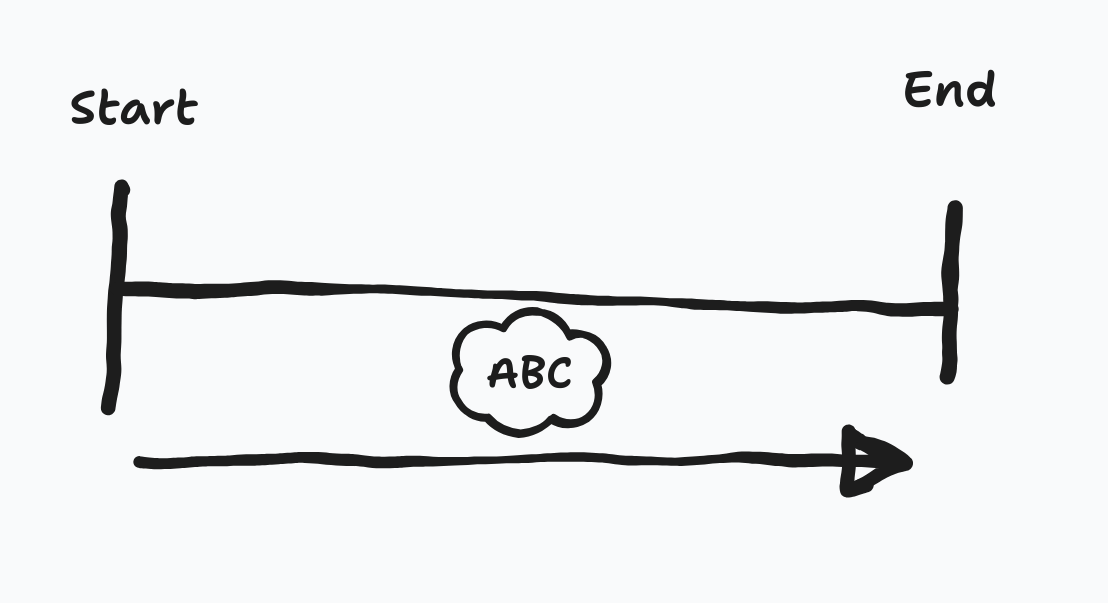
From our perspective within this time segment, it looks as if there is a definitive start to the universe (the big bang) and a definitive end (the heat death of the universe, i.e. the inevitability of entropy).
Infinity would look like a circle with no beginning, nor end. However, contained within that circle you may have segments of time with actual start and ends - which happen to repeat in the same exact manner every single time.
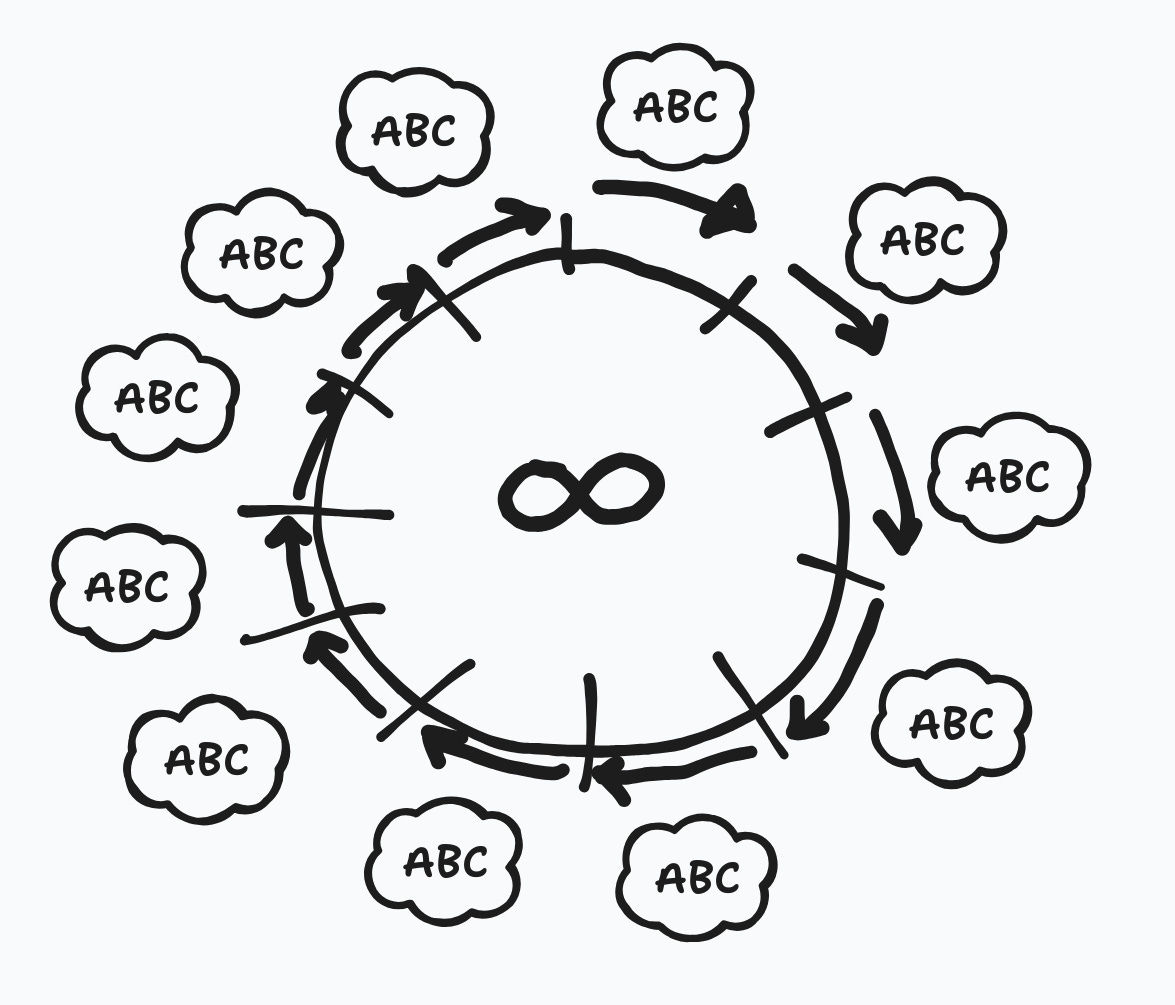
So what have we achieved with this perspective? That both infinity (rebirths, multiverses, etc.) are possible. However, this initial perspective leaves us with a reality that appears (to all within the time segments/universes) exactly the same. A birth, a death, and what appears to be nothing after the death.
None of the inhabitants of that time can extend their life beyond the end of the heat death. None of them can impact the other time segments. What happens in one time segment happens in all of the others.
The same week I wrote this draft, with these matters already on my mind, I listened to a debate between Jordan Peterson & atheists. That is if you can call it a debate...
I do not endorse the channel on which I saw it, or Jordan Peterson himself, but I digress. You can watch it for yourself here if you are interested.
For me, it was amusing how Peterson's position of no position gets the same creation some people have when observing that the creator doesn’t advertise its existence to everyone. This might sound out there, but if we imagine it is not Peterson responding, but rather God, and we imagine the debater Danny as a religious doubter, this conversation takes on a different meaning:
Jordan: Why are you asking me that?
Danny: Because you're a Christian.
Jordan: You say that. I haven't claimed that.
Danny: Oh what is this? Is this Christians vs Atheists?
Jordan: I don't know.
Danny: You don't know where you are right now?
Jordan: Don't be a smartass, and I mean that.
Danny: Well, either you're a Christian or you're not.
Jordan: Cuz I won't talk to you if you're a smart ass.
Danny: Oh, either you're a Christian or you're not. Which one is it?
Jordan: I can be either of them but I don't have to tell you.
Danny: You can be - you don't have to tell me? I was under the impression that...
Jordan: It's private.
Danny: I was invited to talk to a Christian. Am I not talking to a Christian?
Jordan: No you were invited to...
Danny: I think everyone should look at the title of the YouTube channel. You're probably in the wrong YouTube video.
Jordan: You're really quite something you are.
Danny: Aren't I? But you're really quite nothing. Right, you're not a Christian.
Jordan: Alright, I'm done with him.
In the conversation above, what's interesting is that people often expect God, an omnipotent, omnipresent, all knowing being, to magically respond to them in the form that they desire to prove that God exists. People ask God 'are you real? If you are, then you would respond,' and when God is silent on the matter, we conclude that God does not exist.
The amusing part of the debate, if you can even call it that, is that Jordan says you're quite something, and Danny responds 'you're really quite nothing.' It's amusing given that everything everywhere all at once is also nowhere in particular. Without a frame of reference everything collapses into nothing.
By choosing not to take a vocal position towards Gods' own existence, we conclude that God is nowhere - while to God it would appear that God is everywhere from the rays of sun to the quarks that make up the atoms of the universe.
Later in the 'debate' another debater named Ian states that:
"… presumably a perfect being would be revealing all of these aspects all the time, especially if God's outside of time. That just seems incoherent to me... at the point in time where God created us he could have created us in a way where we would always be receptive to these principles, where we don't have to go across a learning curve... Also if you believe in an all knowing God free will is impossible."
While that is a mouthful and may appear incoherent itself, it provides a broad perspective of doubters' claims. I might add that these are claims I have used myself in the past when doubting God's existence.
Ian goes on to goes on to state that people like Graham Oppy make arguments about the incompatibility of omniscience and free will, that:
"… if God created this world instead of that world then he makes it causally inevitable every single action that you are going to make. If he made a world where we were electrons and love, then none of this would have happened. But by making us in this world, knowing exactly what is going to happen in the future it makes all of those events inevitable, which means that they're all causally determined, which we means we have no free will if you believe in an all good God or an all knowing God that made everything."
Peterson's response to all of that? He says, "well, have it your way."
The reality is that when we try to use linguistics to limit nondeterministic timeless beings we end up capturing the essence of things as much as fishermen capture the essence of the sea through their cages. That is to say, we are left with arguments that have more holes than Swiss cheese. I will elucidate some of those holes.
Such wordy arguments appear intelligent but in actuality they ignore the paradox of what it means to be omnipotent. An omnipotent being can know what will happen just like I know I will die, without it meaning that I am the arbitrator of my own death. By simply living I know that I will die, because everything that came before me has died and everyone ever known to have lived has died (in the flesh and blood).
In the same vein that it is an obvious thing for me to predict my own death, God can predict everything that will happen without being the reason that it happens.
Furthermore, let us consider that at a fundamental level, knowing, as we experience it, requires memory. One may know something and also forget it. Romans (i.e. humans) for example knew how to make concrete using volcanic ash that self heals, then forgot how to make it for thousands of years.
Was it that humans did not know how to make this concrete during that time? Or is it that the expression of that knowledge, previously held, was intermittently unavailable or possibly even used in secret without our awareness of it? It seems like a silly random aside. However, for a timeless being the act of 'forgetting' that it exists is as possible as the act of breathing in and out. Sometimes we relegate this act to our subconscious, sometimes we briefly forget how to breath (if we suffer some physical or mental trauma), and other times we are fully aware of the breath. Simply forgetting how to breath, or taking control of our breath from time to time does not mean that we ceased to exist or that our breath ceased to exist during the moments that we did not breath.
God can go in and out of knowing because if God couldn't then that would produce a paradox of omnipotency (yes, that’s a word - I checked). Likewise, God can be aware of everything that will happen, even those things that God does not control. Your free will (and everything you will ever choose) is as obvious to God as death is the inevitable obvious end of everyone that is alive.
If we consider the intelligent design in which God shows us the eternal design everywhere, then there is also a nothingness which shows us absolutely nothing. There has to be a nothingness which shows us absolutely nothing for there to be something that shows us anything. This is why the 'you're quite something,' and the 'you're quite nothing,' paired with the 'have it your way,' from the debate takes on a new meaning for me. A position of no position is the very position God could take.
When we approach ideas with a rigid concreteness, we block ourselves from consecration of the divine. Revival of the concrete, the understanding of the sand that made it so, along with the rivers and oceans that bore it from an unassuming rock over billions of weather cycles and countless planetary and space formations is what makes the concrete re-concrete (i.e. that which is real again).
This conversation between seemingly two rocks (Peterson and another debator) seems random, of low value (to the person taking the side that is contrary to that of their own), and is lost in a sea of arguments for the sake of arguments.
For myself, as I personally consider the inner-workings of the universe and how both sides reconcile, an inner peace emerges. Good and the opposite of evil... Is there anything but?
In the same way that the universe repeats itself with no start or end, there is only a gradient between here and now. God gives the option of heaven and hell, but not nothing. Even that may be an indication that not experiencing is not an option freely given. Yet we are aware that the planets themselves are suspended in nothing but a vacuum of space and a lattice of celestial energy (gravity) that we are told cannot be created nor destroyed.
No matter what options are given, there is space and a lack of it across all of space and time. All avenues are compatible with each other. Even the reality where one desires to not go to heaven, nor hell, nor nirvana, nor to be reborn, that reality does exist. It has to exist. Without it, God couldn't exist in the infinite form.
Imagine that God decided at this point in time to cease existing. What would happen? A paradox? A reboot of all realities across all space and time? God can cease to exist at any time. What is left? God which has not ceased to exist.
This one might be more difficult to grasp. How else could a God that must know all, including not knowing, be able to float away into the ether other than to permit God to fractal into nothingness whenever desired?
When I attempted to research one concept from the The Cognitive-Theoretic Model of the Universe, I came to realize that even its author with all his high IQ may have not been able to overcome the human propensity to make sense of a limitless being whilst using a limited brain. In a recent interview with Michael Knowles, Christopher Langon (the creator of the CTMU), seems to delve into topics such as 'humans' mistakes' in light of the universe God produced, as well as the reality of the devil, and some abstractions for what refusing God (and going to hell) would look like from the perspective of God (knowing you're there but no longer acknowledging you). Unfortunately, these types of discussions, while thought provoking, fall flat on their face because they attempt to box in God. As if God can make mistakes!
When humans invent some harmful thing that pollutes water, reduces lifespans, or creates other problems, we think of them as 'mistakes,' yet when God orders the destruction of people for one reason or another we (believers) look it as divine will. The reality is that the reality around us, with all of its 'mistakes' and shortcomings, is exactly what God has willed. Since God has created this universe and its constraints, there are no mistakes. There is only divine will and evolution of individual awareness, but I digress.
What did make it with me all these years, from the original readings into the CTMU nearly a decade ago, is that existence is contained within nonexistence. While the author of this theory may have opinions far outside of universal matters (that delve into geopolitics and other topics), and while I do not endorse Christopher Langan in any manner, I am grateful for the reference point of 'existence existing within nonexistence.' It’s the type of koan that helped articles like this spring to life.
Back to what I consider more approachable, I will expand upon the mind map of the time segments. This time, imagine that the circle is not composed of time segments (of big bang to big crunches that are identical) but rather, of time segments that are different. In such a construction, a variety of universal realities could take place. However, even that would have its limits.
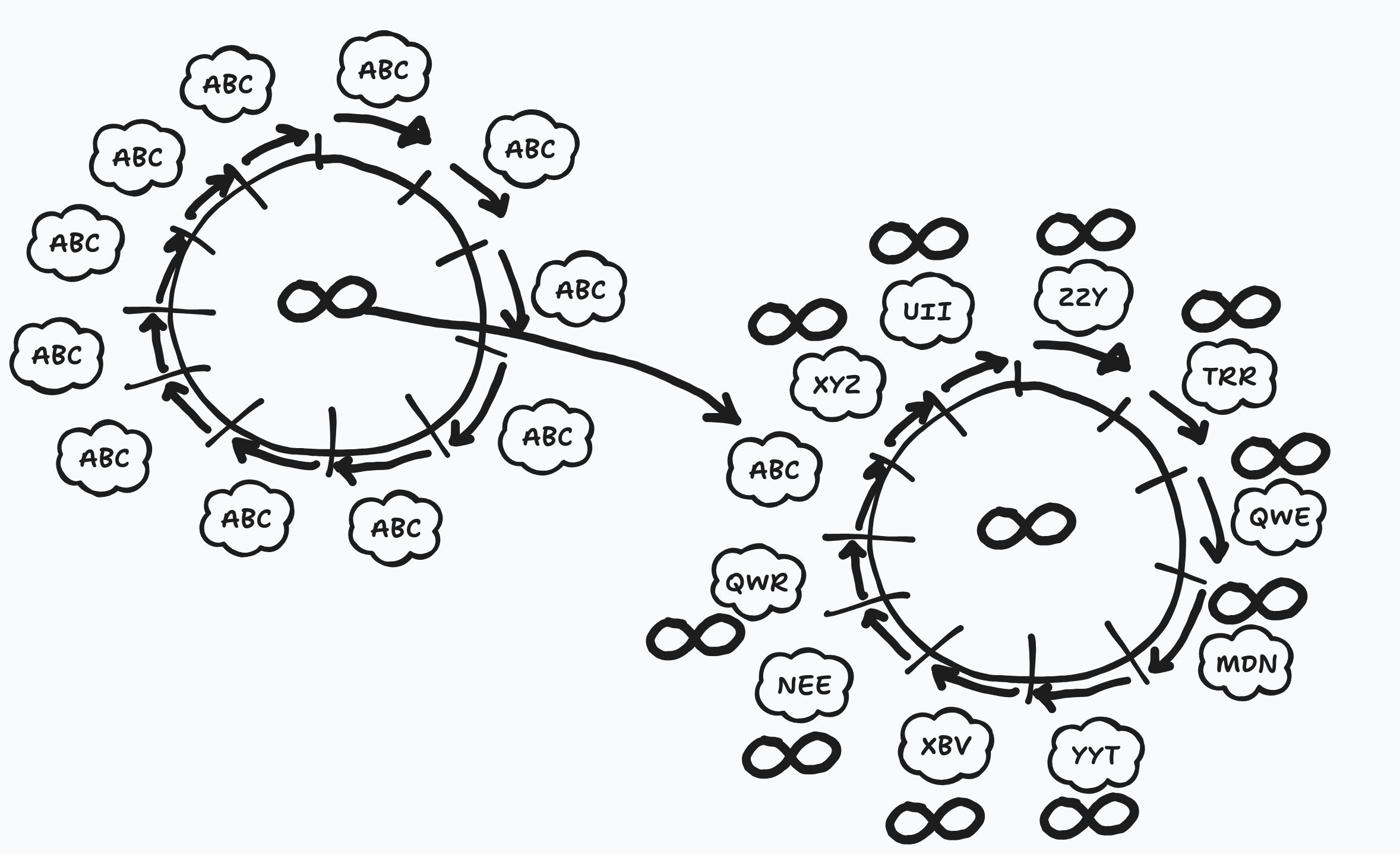
For example, in physics there are theories which postulate that only a certain amount of universes (with certain physics parameters) could ever exist. So in other words, there may be an infinite multiverse but one that is only made up by a finite amount of building blocks of physics.
To put it more plainly, we might imagine a reality in which a single strand of someone’s hair ends up being a different color at a particular point in their life. Everything else turns out relatively the same, and then the universe continues to its heat death, into a big crunch, followed by another big bang; and it happens again and again. Eventually these small changes lead to noticeable variations between universes. However, in this example, after trillions of iterations the changes would still adhere to the same physics as the current world that we understand. It would not contain variations in which a person teleports from one place to another simply by thinking about it, or bends spacetime in order to go back into the past or travel to the future. It also would still adhere to the general 'start' of the big bang and the heat death of that particular universe, without being able to jump across lineages between universes held in the multiverse.
Where Christopher Langan speaks of hell as being the place you go when you reject God, I would argue that hell is being trapped in an unfavorable time segment (with a definitive start and end) which does not have variation. Not only that, but you’d have to end up there to ensure that God is all powerful. You’d end up in such a reality so that it’s clear that God can relegate your consciousness to experiencing an unfavorable reality for all of eternity.
Who knows? Maybe hell is where the most ardent atheists go for God to prove that it does exist (I kid).
To say that you can end up in hell by rejecting God is actually beyond my comprehension and the scope of this article. What I can discuss, in the example of time segments, is how one might experience only a repetitive existence rather than a varied one.
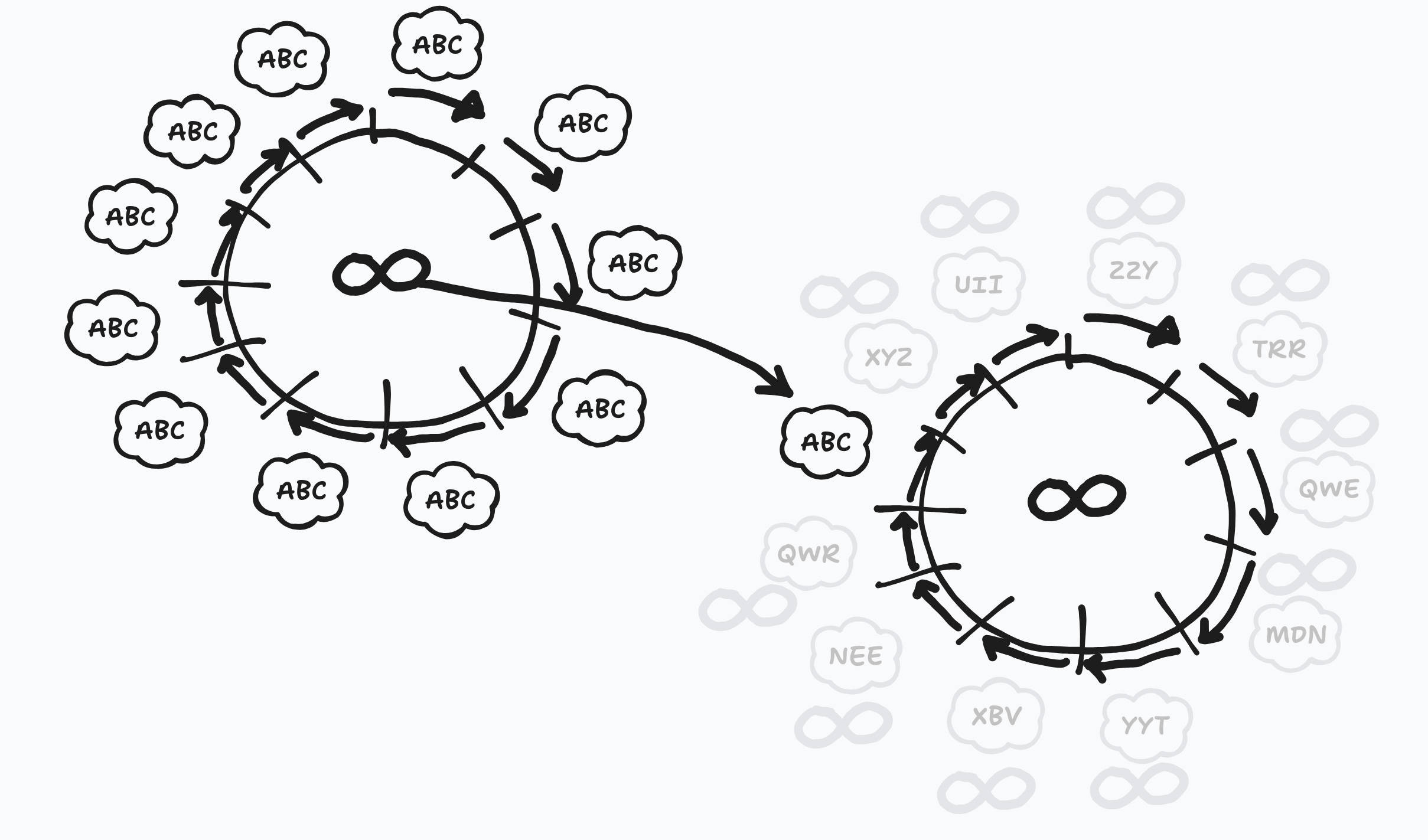
Remember how we covered that God has to be able to forget, and by forgetting God does not cease to be, in the same way that by ceasing to breath momentarily we do not cease to live? In that same manner, God can become 'asleep' to certain realities. So that if in this infinite circle of universal rebirths, with variations that are still within our understanding of physics, God becomes asleep or unaware of the ones that are not repetitive, then we achieve the construct of reality in which a start to end atheist's view of reality exists exactly as per their perspective in an ocean beyond their view.
This is the effervescence, the constant bubbling, of the forever Dharma wheel. The true disconnect, the non reincarnation, the non existence that is the vacuum in which the bubbles reside; where God permits not knowing. Where God floats away into the ether and fractures into nothingness as God pleases - to uphold the non-paradoxical reality of its being.
And if God decided to produce paradoxes? What if God decided to yield universes in which the laws of physics are broken. What then?
At that point we would have completed the circle. God has to, by definition, be able to produce paradoxes in order to be omnipotent. The very paradoxes that you think of as impossible or silly, the very paradoxes that take endless amounts of words from your dutiful author or those of others with much higher IQ... those paradoxes are exactly what is possible and must be attainable by God for God to be God.
So what’s the 'have it your way' take away?
What are some of the ways you can proceed from here?
Believe in a heat death of the universe with no big crunch and no after life.
Believe that God produced a finite universe which does have a heat death but no big crunch/recurring big bang. People go to heaven, or hell, or they achieve nirvana after living a certain amount of rebirths across a singular start to end narrative of humanity, possibly re-birthing into all beings that lived or will live, but only within one singular universe.
Believe a variation of #2, a worldview where there is a multiverse that contains additional variations which produce no paradoxes.
Believe a variation in which a multiverse does contain paradoxes.
Believe in something different.
In the end of the day, what you believe is up to you and what your creator gives you the opportunity to believe. If there is anything I'm certain of it's that at the base layer of reality there is a God which is omnipotent, omnipresent, all knowing, and conscious. This creator made the planet, it made you, and it made everything that makes it possible for you to be here now. God even makes it possible for you to eventually not be here now.
What I originally wrote to jot down my observations, which was confusing for mostly anyone else to read, evolved into a slightly better approach which you can be the judge of. I hope that other people may explore the concepts through their own viewpoint.
If you are interested in considering this from a different perspective, you may find it enlightening to read about Anekantavada.
"Anekantavada, or the Jain doctrine of "non-one-sidedness," is the philosophical principle that reality is complex, multifaceted, and possesses infinite attributes. It asserts that no single, human viewpoint can grasp the absolute truth, as all knowledge is partial. It encourages tolerance, intellectual non-violence (ahimsa), and pluralism by validating multiple perspectives on a single entity."
The beauty for me of the perspective shared, and how Anekantavada manfiests, is that I do not have to learn complex math, invent new words, write research papers, or advance philosophy or theology to convince people of what I believe. If someone believes something that is contrary to what I’ve shared it is already integrated in my world view in the complex reality of the universe. It isn't an anomaly, it isn't a mistake, it isn't ignorance, it isn't anything but what it is.
An infinite consciousness, being... existence existing at scale.
Thanks for reading this far! I’d love to hear your comments below.
If you enjoyed this and want to stay current with my writings, please subscribe below.
Endorsement Disclaimer:
As mentioned throughout the article, I do not endorse Jordan Peterson, Christopher Langan, or Michael Knowles. I do not endorse any other thinker or their works.
I also make no assertion as to which religion (or if any of them) is the ultimate ‘gatekeeper’ to understanding reality and living a good life. I also make no claim as to whether a lack of religion is better than being a believer.
While I do not endorse a specific religion, or its absence, I endorse education, logic, reason, and empathy. I urge people to discover what is true to them.